
By Ihuoma Jennifer Metuaghan
NCMM Abuja
February 12, 2024
Prologue: Objects Out of Place
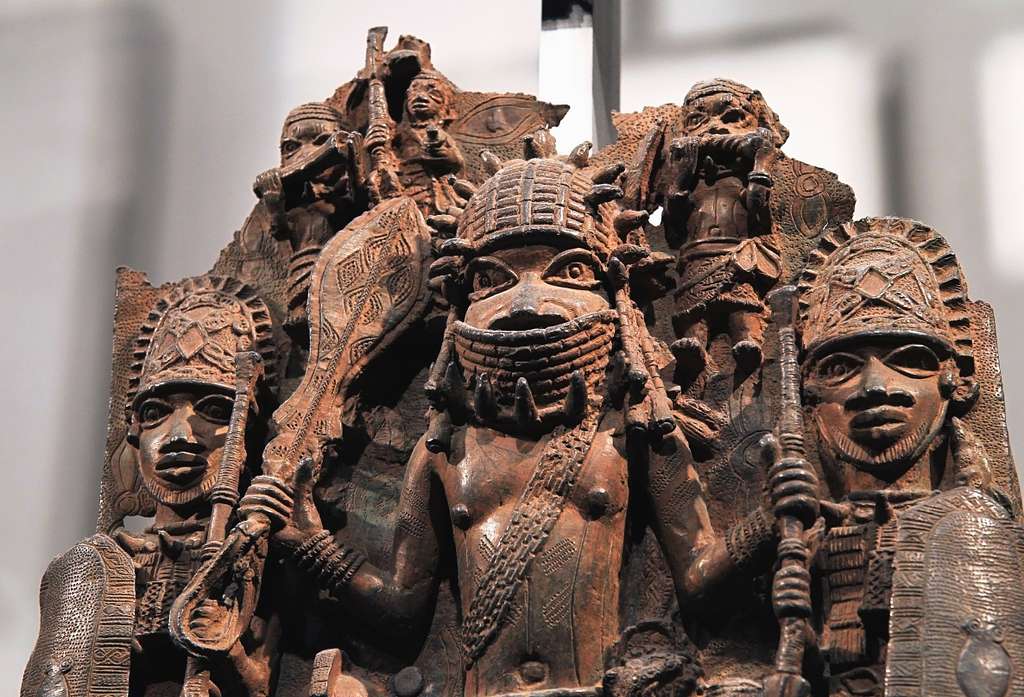
Walk into the British Museum, the Ethnologisches Museum in Berlin, the Metropolitan Museum of Art in New York, or any one of roughly 160 institutions scattered across Europe and North America, and you may encounter them: cast brass plaques of extraordinary intricacy, ivory carvings of breathtaking refinement, bronze heads of regal serenity. These are the Benin Bronzes, though the label is a convenient fiction, since many are ivory, terracotta, or wrought iron, and “Benin” refers not to the modern West African nation of Bénin but to the ancient Kingdom of Benin, in what is today southern Nigeria.
There are over 5,000 of these objects held in Western collections. Almost all of them arrived there the same way: looted during a British military operation in February 1897, an action the Royal Navy called a “Punitive Expedition.” The story of how they were taken, and the long, fractious, still-unresolved struggle to return them, sits at the heart of a broader global reckoning with colonialism, cultural property, and institutional accountability.
The Kingdom of Benin
To understand what was lost in 1897, one must first understand what existed before it.
The Kingdom of Benin, Igodomigodo in the Edo language, ruled from the city of Benin (present-day Benin City, Edo State, Nigeria), was one of the oldest and most sophisticated polities in sub-Saharan Africa. Founded around the 11th century CE and reaching the height of its power between the 14th and 17th centuries, it maintained a complex bureaucratic state, extensive trade networks stretching to North Africa and Europe, and a royal court of considerable cultural achievement.
At the centre of that culture was the art of bronze/brass-casting, practised exclusively by a hereditary guild of craftsmen, the Igun Eronmwon, who worked under the direct patronage of the Oba, the divine king. Working by the lost-wax (cire perdue) method, these artisans produced objects of startling technical mastery: plaques commemorating royal deeds, ceremonial heads placed on ancestral altars, carved tusks, royal regalia. The so-called Benin Bronzes were not decorative objects for trade or display; they were living archives, sacred relics, instruments of governance and spiritual life, embedded in the rhythms of court ceremony.
Portuguese traders who arrived in Benin in the 1480s were astonished. The city’s wide, clean avenues and its palace, which one early visitor compared favourably to Lisbon, defied every European assumption about Africa. The kingdom thrived through centuries of trade, war, and diplomacy, navigating the Atlantic slave trade with a mixture of participation and resistance. By the 19th century it remained powerful, though increasingly hemmed in by the expanding apparatus of British colonial rule in the Niger Delta.
The Road to 1897
The immediate trigger for the 1897 expedition was an incident that remains contested in its details, though not in its broad shape.
By the 1890s, the British had established the Niger Coast Protectorate and were pressing Benin, one of the last substantially independent polities in the region, to accept a trade agreement and British oversight. The Oba at the time, Ovonramwen Nogbaisi, was deeply reluctant. The palace at Benin maintained strict ceremonial protocols; certain seasons were declared closed to outsiders, and the Oba’s person and sacred precincts were not freely accessible.
In January 1897, Acting Consul-General James Phillips decided to travel to Benin City to force a meeting, despite being warned that the Oba had declared a ceremonial period and that the timing was inauspicious. Phillips dismissed the warnings. His party of around 250 men, British officials, a small armed escort, and African porters, set out without authorisation from London. They were ambushed, likely on the orders of palace chiefs acting without the Oba’s full knowledge or consent. Phillips and six other British officers were killed.
The British response was swift, overwhelming, and predetermined. A punitive force of some 1,200 men under Admiral Sir Harry Rawson was already being assembled before the ambush; the Colonial Office had long coveted Benin’s subjugation. Within weeks, the force moved on Benin City. Facing no possibility of effective military resistance, the Oba fled. The city was entered, the palace ransacked, and significant areas, including the royal compound, were burned, either deliberately or through accident. The Oba was eventually captured, tried, and exiled to Calabar, where he died in 1914.
What the soldiers found in the palace was extraordinary. Thousands of brass plaques, heads, figures, ceremonial objects and royal regalia filled storerooms and altars. Many had been there for centuries. The British were simultaneously awed and dismissive, unable to believe that Africans could have made objects of such quality. For years, some scholars floated theories, later thoroughly debunked, of Portuguese or even Egyptian manufacture. The objects were packed up and shipped to Britain. A portion went directly to the British Museum; others were auctioned off to cover the costs of the expedition. The kingdom’s cultural patrimony was dispersed across the globe.
The Legal and Moral Architecture of Repatriation Claims
The repatriation of the Benin Bronzes is not simply a moral argument; it is a complex legal and diplomatic entanglement shaped by competing frameworks.
The Nigerian claim rests on several pillars. The objects were taken by military force in an act of colonial aggression. They were the property of a sovereign polity and its ruler. Their removal was, by any reasonable contemporary standard, theft. The Nigerian state and the royal court of Benin have consistently demanded their return, a position formalised by the Benin Dialogue Group, a forum including Nigerian federal and state authorities, the Oba’s palace, and major holding institutions, established in 2007.
The institutions’ defences have historically rested on several grounds, some legal, some philosophical. The British Museum, for instance, is constrained by the British Museum Act 1963, which explicitly prohibits the deaccession of objects in its collection with narrow exceptions. Trustees have long argued they lack the legal power to return objects even if they wished to. Other museums have invoked the concept of the “universal museum”, the idea that great encyclopaedic collections serve all of humanity, that objects are better preserved and more accessible in London or Berlin than in Lagos or Benin City.
These arguments have worn thin. The “universal museum” concept, articulated most baldly in the 2002 Declaration on the Importance and Value of Universal Museums signed by 19 major institutions, has been widely criticised as self-serving. The access argument presupposes that a Nigerian citizen is better served by flying to London than by visiting her own country; it assumes preservation standards in the Global South are necessarily inferior; and it ignores the profound difference between physical access and spiritual and cultural connection, the latter inextricably bound to the objects’ original context.
The legal barrier in Britain has been addressed creatively by other countries. In 2021, Germany’s parliament passed legislation explicitly permitting federal museums to return objects acquired through colonial violence, clearing the path for significant repatriations. The Netherlands followed. France, under a 2021 law, authorised the return of 26 objects to Benin Republic (the modern country, not the kingdom) and Senegal, signalling a shift in the broader European political landscape.
The Return Begins, Partially
The years since 2020 have seen a cascade of announcements, agreements, and partial returns that represent genuine movement, though the picture is complicated.
Germany committed to returning its entire Benin Bronze collection, numbering some 1,100 objects. In 2022, the Ethnologisches Museum in Berlin formally transferred ownership of 512 objects to the Nigerian government, with physical handovers following. Other German institutions, Hamburg, Stuttgart, Cologne, made similar pledges.
The Smithsonian Institution in the United States announced in 2022 that it would return 29 Benin Bronzes. Cambridge University’s Jesus College returned a single Benin cockerel, “Okukor,” to Nigeria in 2021, a small but symbolically charged act.
France returned several objects, as did Austrian institutions. The Royal Collection Trust in Britain confirmed that a number of Benin objects held by the Crown would be returned.
The British Museum, however, which holds the largest single collection outside Nigeria, some 900 objects, has not returned any pieces. Its trustees maintain that the 1963 Act prevents deaccession. In 2023, a proposed “loan” arrangement, whereby Nigeria would “borrow” objects that are legally its own, was greeted with considerable anger by Nigerian officials and cultural figures, who pointed out that lending sovereign property back to its owners hardly constitutes restitution. Negotiations have stalled repeatedly.
The Nigerian side has not been without its own complexities. The newly constructed Edo Museum of West African Art (EMOWAA) in Benin City, designed by British-Ghanaian architect David Adjaye, was intended as the institutional home for returned objects, but its construction has faced some political difficulties. There is also an ongoing debate within Nigeria about governance: should returned objects be held by the federal government, Edo State, or the Oba’s palace? The question has political dimensions that have sometimes slowed the repatriation process.
The Deeper Questions
The Benin Bronzes sit at the junction of several profound and unresolved questions that extend far beyond any individual collection.
What does repatriation actually mean? Physical return is the minimum demand. But repatriation advocates argue that meaningful restitution requires acknowledging the violence of the original acquisition, understanding the sacred and political significance of the objects, and ensuring that returns are made to the right custodians, ideally the communities and institutions that are the cultural heirs of the original owners, not simply the contemporary nation-state.
What are the limits of legal permanence? The argument that a museum’s founding legislation prevents it from doing the right thing is a peculiar moral position. Laws change. The question is whether political will exists to change them. In Britain, where the debate is most acute, there is growing parliamentary pressure to amend the British Museum Act, though successive governments have declined to act.
What precedent does repatriation set? Holding institutions have long worried about the “floodgates” argument: if Benin Bronzes go back to Nigeria, does the Parthenon Marbles go back to Greece? The Rosetta Stone to Egypt? The Koh-i-Noor diamond to India? Proponents of repatriation argue this is a feature, not a bug, that reckoning with the colonial origins of encyclopaedic collections is an overdue moral obligation, not a catastrophe to be forestalled. Every case has its own specific history and legal context, and the fear of precedent should not be used to prevent individual justice.
Who speaks for the objects? The Benin royal court, the Nigerian state, the Edo people, the global art-viewing public, future generations, all have claims on these objects. Navigating competing claims of ownership, custodianship, and access requires genuine dialogue rather than unilateral institutional decision-making.
A Bronze Head’s Journey
Consider a single object: a brass memorial head of an Oba, cast perhaps in the 17th century, removed in 1897, auctioned in London, acquired by a European museum, catalogued under a colonial taxonomy, displayed behind glass for 125 years. Its original function was to hold the spirit of a dead king, to anchor ancestral veneration, to serve as a site where the living spoke to the dead. In a glass case in Hamburg or London or Chicago, it serves a different function entirely: proof of Africa’s artistic achievement, evidence of empire’s spoils, an object of aesthetic contemplation for museum-goers who know little of its origins.
That gap, between what these objects are and what they have been made to mean in Western institutions, is precisely what repatriation seeks to close. It is not about erasing the objects from Western cultural consciousness. It is about restoring their integrity, returning agency to the communities that made them, and acknowledging honestly how they came to be where they are.
Epilogue: Incomplete Reckoning
The history of the 1897 Benin Expedition is not a history of unique villainy. It is, in its broad outlines, entirely typical of European colonialism in Africa and Asia: a sovereign polity destabilised, a pretext manufactured, overwhelming military force deployed, wealth extracted. What makes the Benin case singular is the quality and quantity of what was taken, the richness of the documentary record, and the sustained, organised demand for return.
Progress, in 2025, is real but partial. Hundreds of objects have been returned or pledged. The conversation has shifted irreversibly: the question is no longer whether the major European collections acquired objects through colonial violence, but what obligations that history creates. Yet the British Museum, the symbolic centre of the debate, has not returned a single piece. The 1963 Act stands. The negotiations continue.
The Benin Bronzes remain, for now, scattered, fragments of a single culture distributed across 160 collections in 20 countries, separated from the altars and ceremonies and living communities to which they belong. The 1897 Expedition lasted six weeks. Its aftermath has lasted more than a century, and the accounting is not yet complete.
Sources and further reading:
Barnett Singer & John Langdon, Cultured Force (2004)
Barnaby Phillips, Loot: Britain and the Benin Bronzes (2021)
Felwine Sarr & Bénédicte Savoy, The Restitution of African Cultural Heritage (2018)
Dan Hicks, The Brutish Museums (2020)
British Museum Act 1963; Benin Dialogue Group proceedings.
Leave a Reply